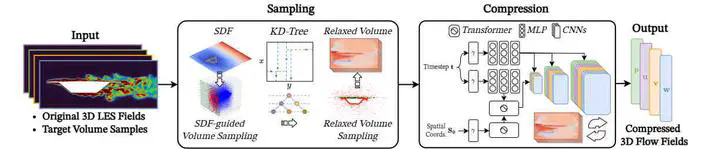
 Diagram of the proposed framework.
Abstract
The increasing reliability of Computational Fluid Dynamics (CFD) simulations has established them as essential tools for aerodynamic analysis and wind-resistant design in many engineering fields. Simultaneous advancements in exascale computing have facilitated the development of large-scale models producing massive datasets. While offering significant advantages, storing and processing these massive datasets, particularly those produced by 3D Large Eddy Simulations (LES), poses a marked challenge for conventional methods. With their ability to directly solve large-scale turbulent structures and model small-scale turbulence, LES simulations provide a highly accurate but storage-intensive representation of aerodynamic phenomena. This work presents a novel compression method specifically designed to address this challenge. The proposed approach focuses on critical flow region compression by employing Implicit Neural Representations (INRs) and the Signed Distance Function (SDF), enabling accurate flow detail reproduction near surfaces of interest. Consequently, a new and efficient neural network architecture tailored for 3D and spatiotemporal compression is introduced. The developed framework delivers more efficient data storage, facilitating flow processing and flow feature visualization. The efficacy of this methodology is tested through a large-scale 3D LES simulation of a bridge deck resembling the Sunshine Skyway Bridge in Tampa, Florida, USA.

Omar A. Mures
My research interests include Deep Learning, Computer Vision and Computer Graphics.