NeVF: Representing CFD simulations as neural flow volume fields for efficient compression, reconstruction, and analysis
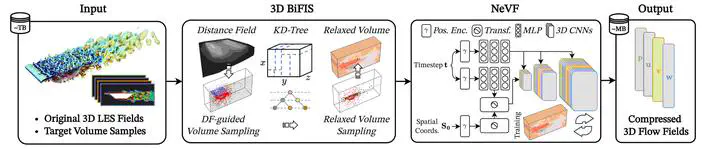 System overview of the proposed image sampling framework.
Abstract
Computational Fluid Dynamics (CFD) simulations of civil engineering aerodynamics, which are commonly characterized by complex three-dimensional flow fields, generate massive spatiotemporal datasets, creating significant storage and computational bottlenecks that heavily constrain iterative engineering workflows. To overcome these challenges, this paper presents a novel two-stage compression framework that models three-dimensional flow field data using Neural Flow Volume Fields (NeVF). The first stage employs a distance field-biased flow importance sampling (3D BiFIS) strategy to reduce data dimensionality intelligently; this approach selectively extracts key near-wall flow information, guided by surface proximity to construct a “relaxed” image volume. Subsequently, a deep network, leveraging positional encodings and disentangled spatio-temporal attention mechanisms, highly compresses this volumetric representation. The effectiveness of the resulting flow field representation is evaluated using a comprehensive 3D Large-Eddy Simulation (LES) dataset of a bluff single-box bridge deck, characterized by complex, uncorrelated spanwise flow features. Results demonstrate high data compression rates of ∼7000:1 to ∼30,000:1 while preserving high-fidelity near-body aerodynamic flow features, enabling accurate estimation of wind-induced forces. Ultimately, our methodology streamlines efficient storage, reconstruction, and rapid analysis of exascale CFD datasets, unlocking potential new applications for deep learning emulation and data-intensive tasks, such as, uncertainty quantification and flow-driven aero-structural optimization. The neural compression code is available on GitHub.

Omar A. Mures
Instructor
My research interests include Deep Learning, Computer Vision and Computer Graphics.