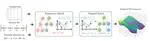
Precisely emulating aeroelastic phenomena and fluid-structure interaction (FSI) parameters as a function of bluff body shape, largely governed by complex aerodynamics, presents a significant challenge. Symbolic Regression (SR) offers a viable alternative as a trend model-free methodology that learns from the data and determines the optimal functional form of the model, along with its associated parameters. It circumvents the need for predefined basis functions that can negatively impact predictive performance. This study proposes a two-stage SR methodology for search and refinement of discovered expressions and examines its efficacy for emulating FSI parameters, specifically focusing on predicting the flutter derivatives of a bluff bridge deck as a multivariate function of its geometric shape, reduced velocity, and angle of attack.